The $20 Rule-Explained Simply
The SSI $20 rule deducts from countable income, while the Medicaid $20 adjustment raises the income limit cap so people who qualify for SSI also qualify for Medicaid or other Medicare Savings Program Buy-In (MSP).
The same $20 shows up in two different places, for two different reasons.
| $20 General Income Exclusion (GIE) | Federal Poverty Level (FPL) + $20 |
|
|
|
|
|
|
|
|
|
|
ABD Buy-In Programs: How to calculate and code unearned and earned income
The following are examples of calculating and coding unearned and earned income on ABD cases.
CASE EXAMPLE 1:
Billy Wright has both RSDI Income and earned income. He receives $1124 RSDI income. He also works and earns $950 a month.
The GIE should be deducted from the unearned income 1st.
$1124 – 20 = $1104
Apply Earned Income Formula: (Gross Earned -$65)/2
Earned income deduction: ($950 – $65)/2 = $442.50 ($443) countable earned income. No additional GIE is given as it was all used during the unearned calculations.
Diverted Income Calculation $950 – $443 = $507 + $20 = $527
Total Countable Income is $443 + $1104 = $1547
RSDI box: $1124
Earned income box: $950
Diverted Box: $527
Review total countable income and refer to Appendix C-1 for eligible buy-in program. In this example, Billy is eligible for SLMB.
ABD Buy-In Programs: Buy-In Example with No Earned Income
John McEnroe receives RSDI in the amount of $1150 and has Medicare Part A and B. He has applied for medical assistance.
Since John only has unearned income (SSA) the full $20 GIE is applied here. $1,150 – $20 – $1130.
There are no other exclusions (since there is no earned income).
John’s countable monthly income for MSP = $1,130 (John is eligible for QMBP based on C.1 (04/01/2026).
RSDI Box: $1150
Diverted Box: $20
How to determine Medical and SSP eligibility using the SDX screen
CASE EXAMPLE
Harry Truman is receiving SSI and RSDI. He’s applied for the SSP and Medicaid.
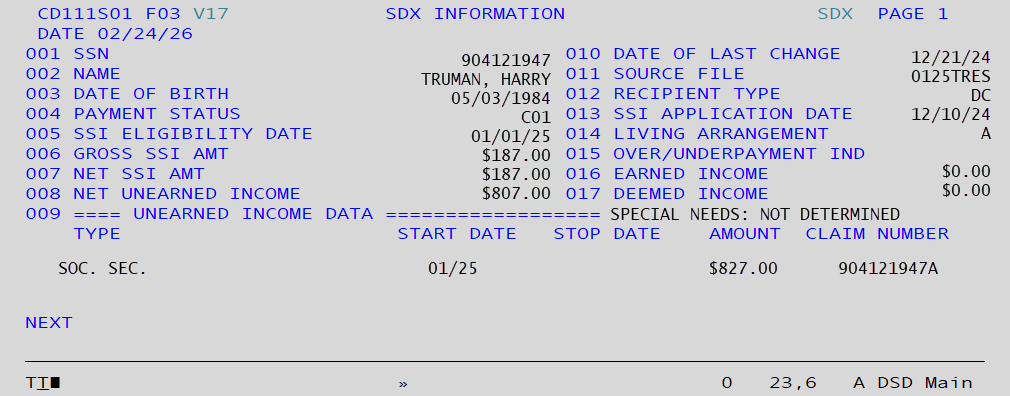
It’s coded in FACS like this.
$827 RSDI
$187 SSI
*Do not code the $20 GIE in the diverted block or any other block. The reduction is already built into the SSI amount. If SSA already counted it, we don’t count it again.

Total countable income is $827 RSDI + $ 187= $1014.00. Review total countable income and refer to Appendix C.1 for eligible buy-in program. Harry is eligible for QMB and $1034 SSP standard-minus $1014 countable income=$20 SSP.
Explanation of How SSI Calculates the Payment:
SSA determines the SSI check like this: Start with the maximum SSI account (FBR). Subtract the person’s countable income. What is left is the SSI payment.
Before subtracting income, SSA applies exclusions such as $20 General Income Exclusion (GIE), $65 earned income exclusion (if working) and Other allowed deductions.
If someone receives SSI, and other income: SSA has already applied the $20 GIE. The SSI amount you see is already reduced. We do NOT need to apply the $20 GIE again to SSI.
Note: The GIE is not used in the income calculation in ADvantage, Nursing Facility, or other HCBW cases. If the LTC case income is within the QMB/SLMB limits without the GIE deduction, then individual would meet the eligibility criteria for the perspective buy-in program.
Comments or Suggestions?
We want Quest to be your source for important information that you need to succeed at in your work but we need your help:
Was this article helpful? Was it missing something you needed to get the job done?
Tell us what you think, what you know about this article. What are we doing well, and what we could do better.
All fields are required.