The unfinished issuance certification process allows different amounts of income to be used from month – to – month to determine the copayment. This process must be used so that an incorrect copayment does not lock in for the next 12 months. The following example outlines the process of considering terminated income in first month and then adding copayment.
**VERY IMPORTANT**
Do not enter the authorization until Section E is coded with Effective Months (E6) = 99
Example
A client applies for child care assistance on 11/25 to retain employment at a new job. She was terminated from her previous employment on 11/15 and received her final check on 11/20/17. Her total terminated income for the month of November 2017 is $1500. The client will receive her first partial check from her new job on December 8 and her first full pay check on December 22. Her anticipated income from the new job is $2,400 per month. The income should be considered as follows:
November = $1500 terminated income
December = $0 ($2400 anticipated income diverted)
January = $2400
Certify the Child Care Tab (Section E) with “Eff Months” (E6) equal to “01” (the number of months that the terminated income should be considered for the copayment). In this example November is certified with a copayment based on the client’s terminated income of $1500
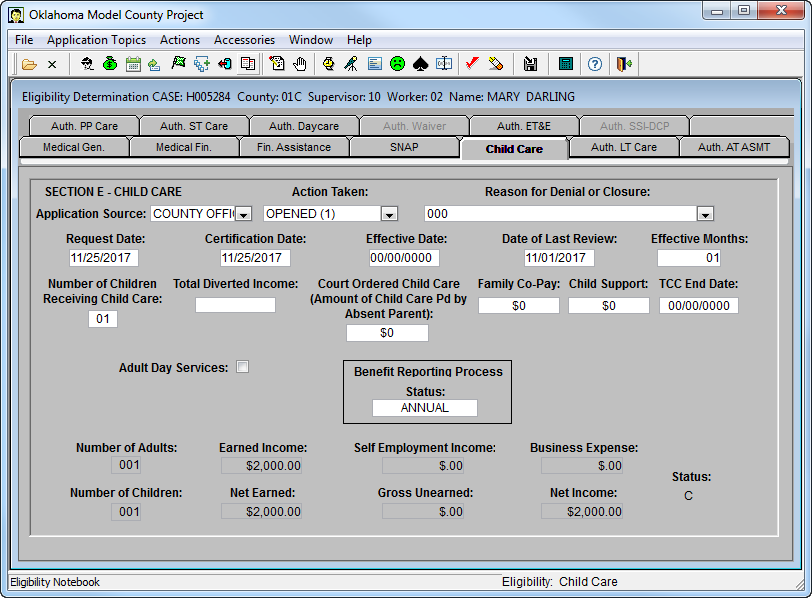
- **SAVE THE CASE and PUSH CASE completely through**
Now, remove the $1500 terminated income and enter the $2400 anticipated income on the case. Code a change action on the Child Care tab for effective date (E5) of 12/01 and resend the “01” that is currently coded in “Eff Months” (E6). Also code $2400 in the “total diverted” (E47) block. This coding will change the copayment to $0 for the month of December 2017 as the client will receive no further income from her old job but hasn’t received a full pay check from her new job yet
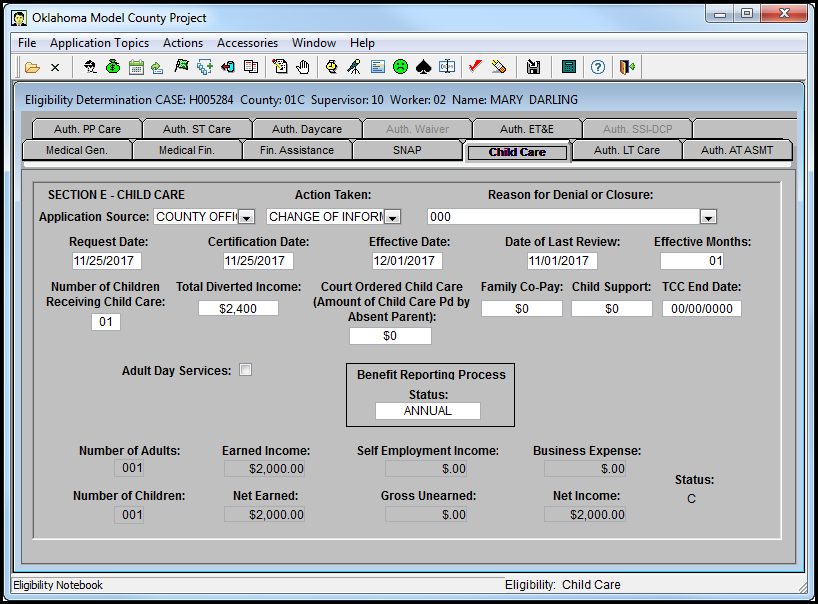
- **SAVE THE CASE and PUSH CASE completely through**
- Resend the change action in the Child Care Tab for effective date (E5) of 01/01 and delete the $2400 income that is coded in the “total diverted” (E47) field. Then, update the “Eff Months” (E6) to equal “99”.
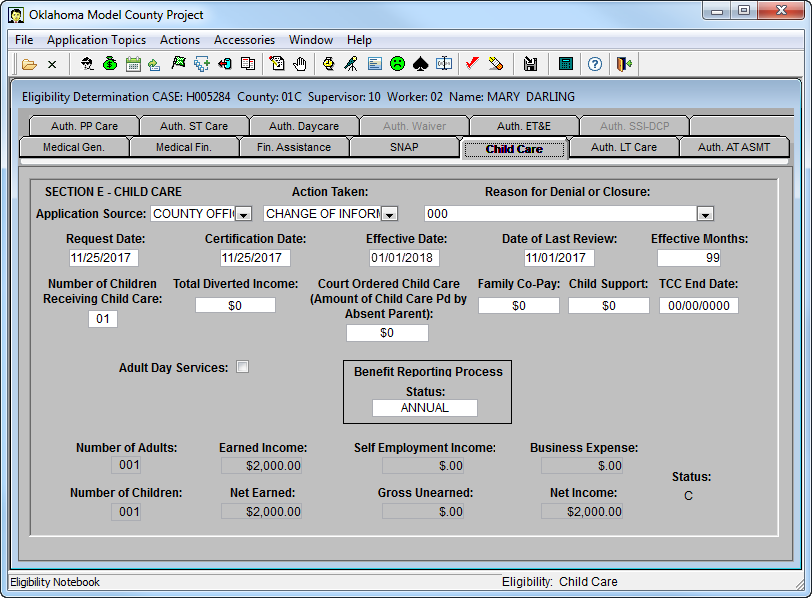
- Enter the child care authorizations on the “Auth. Daycare” tab with the appropriate begin date.
Remember any other open sections will require a change action also.
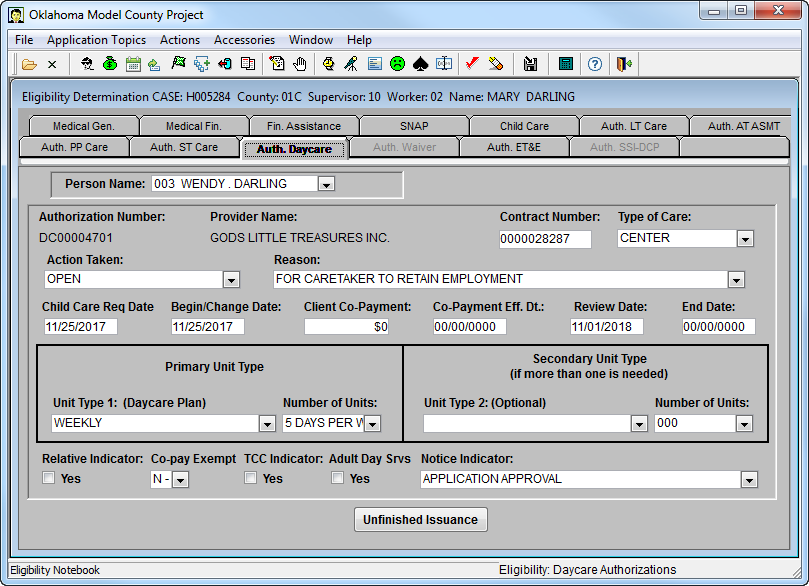
- **SAVE THE CASE and PUSH CASE completely through**
The system will correctly map the copayments for each month to the authorizations. There is no need to enter change actions month-by-month on the authorizations. A single notice will issue to the client showing the copayment amounts for each month.
Comments or Suggestions?
We want Quest to be your source for important information that you need to succeed at in your work but we need your help:
Was this article helpful? Was it missing something you needed to get the job done?
Tell us what you think, what you know about this article. What are we doing well, and what we could do better.
All fields are required.